
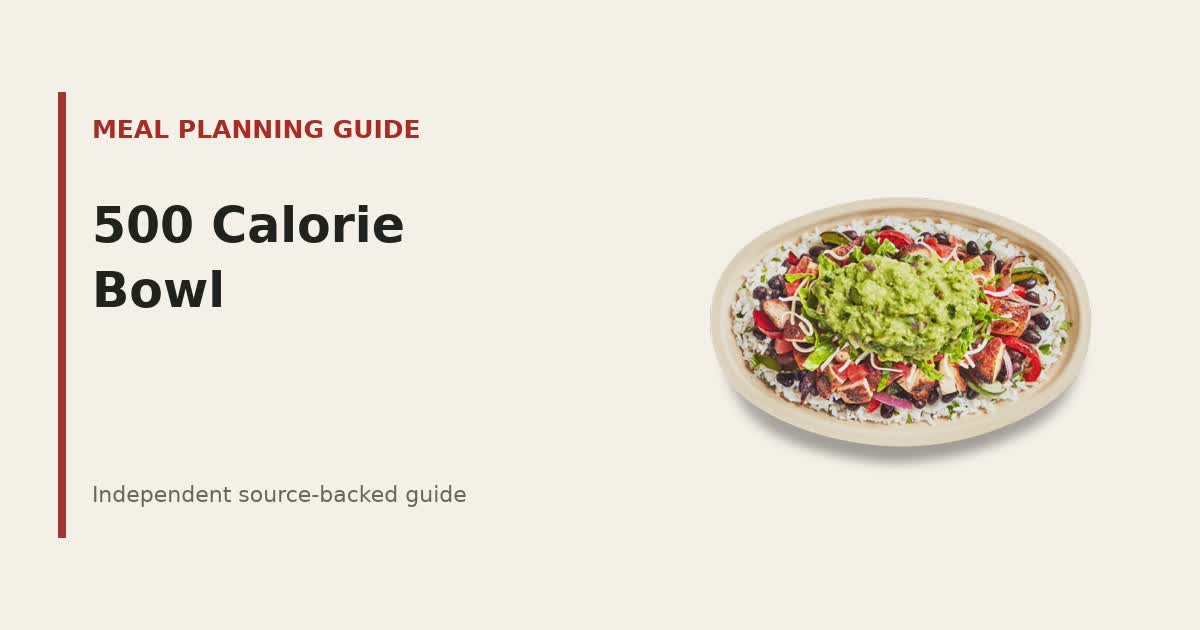
A reproducible Chipotle bowl around 500 calories is Bowl + Steak + White Rice + Black Beans, which totals 490 calories in this site’s dated snapshot. The arithmetic is 0 + 150 + 210 + 130. That leaves only a small amount of room around a 500-calorie planning point, so toppings and sauces should be added explicitly rather than assumed. Open the Chipotle calorie calculator and follow the same order to test each change.
The 490-calorie anchor bowl
The Bowl format contributes 0 calories because it represents a container rather than food. One Steak portion contributes 150 calories, one White Rice portion contributes 210, and one Black Beans portion contributes 130. Added together, those standardized rows equal 490 calories. The example is intentionally short so every component can be traced and reproduced.
“Around 500” is more accurate than promising an exact 500-calorie restaurant meal. The source values describe standardized portions, while a prepared scoop can be larger or smaller. Salsa, vegetables, cheese, sour cream, guacamole, queso, dressing, chips, and drinks are not hidden inside the 490 total. If any of them are part of the order, they must be selected and counted too. Use the Chipotle menu calories guide to match each planned component to its represented serving.
- Bowl starting contribution: 0 calories.
- Steak: 150 calories.
- White Rice: 210 calories.
- Black Beans: 130 calories.
- Anchor total: 0 + 150 + 210 + 130 = 490 calories.
Build the comparison step by step
Choose Bowl first, then add Steak, White Rice, and Black Beans. Confirm that the displayed total is 490 before selecting anything else. Copy that summary as the baseline. Next, add or swap one item, observe the new total, and decide whether to keep the change. Working one step at a time prevents a multi-ingredient edit from hiding which component moved the result.
After calories, review protein, carbohydrates, fiber, fat, sodium, sugar, and any available dietary or allergen context. A number close to 500 does not automatically satisfy an individual nutrition goal. The calculator is an arithmetic and comparison tool, not a diet prescription. The nutrition and sources guide describes each field and the limitations of standardized portions so the result can be interpreted in the right scope.
- Select the Bowl format and reproduce the 490-calorie anchor.
- Copy the baseline before changing protein, rice, beans, or toppings.
- Change one represented row or quantity at a time.
- Review the complete nutrition summary, not calories alone.
What a Chicken swap does
Chicken is 180 calories in the represented adult portion, which is 30 more than Steak. Replace Steak with Chicken while keeping the Bowl, one rice, and one beans portion, and the total becomes 520 calories. Brown Rice and Black Beans produce the same 520-calorie result as White Rice and Black Beans because both adult rice rows are 210 calories. The protein swap, not the rice color, creates the 30-calorie change from the anchor.
That 520-calorie bowl is still reasonably described as around 500 for a broad planning comparison, but it is not exactly 500. Avoid rounding the total down in the article or calculator. If protein is being compared, also note that Chicken is listed with 32 grams of protein and Steak with 21 grams in the standardized serving. Taste, other nutrients, availability, and personal preferences can matter as much as the headline calorie difference.
- Chicken + Brown Rice + Black Beans Bowl: 180 + 210 + 130 = 520 calories.
- Chicken + White Rice + Black Beans Bowl: also 520 calories.
- Steak anchor versus Chicken version: a 30-calorie represented difference.
Rice and bean swaps that preserve the calorie total
White Rice and Brown Rice are both 210 calories per represented adult portion. Black Beans and Pinto Beans are both 130 calories. That means the Steak anchor remains 490 calories if White Rice changes to Brown Rice, Black Beans change to Pinto Beans, or both swaps happen together. The non-calorie fields differ, so equal totals should not be read as identical nutrition.
For example, Brown Rice has less sodium and more fiber than White Rice in the snapshot, while Pinto Beans have one more gram of fiber and one fewer gram of carbohydrates than Black Beans. Use the full summary when those distinctions matter. The calorie equality makes these useful controlled swaps because flavor or another nutrition field can guide the choice without moving the 490-calorie modeled total.
Vegetables and salsa move the bowl above 500
One represented Fajita Vegetables portion adds 20 calories, so adding it to the 490-calorie anchor produces 510 calories. One Fresh Tomato Salsa portion adds 25 calories, producing 515 if it is the only addition. Adding both makes 535 calories. Those totals can still be useful around-500 comparisons, but the ingredients are not calorie-free and should not be omitted from the arithmetic.
Low-calorie additions can have meaningful values in other fields. Fresh Tomato Salsa is listed at 550 milligrams of sodium per represented serving. The goal here is not to discourage salsa; it is to show why the final nutrition summary matters. If both vegetables and salsa are important to the order, count both and accept the transparent 535-calorie modeled result instead of forcing the meal to appear closer to a round number.
- Anchor + Fajita Vegetables: 490 + 20 = 510 calories.
- Anchor + Fresh Tomato Salsa: 490 + 25 = 515 calories.
- Anchor + both: 490 + 20 + 25 = 535 calories.
Guacamole, cheese, and dressing need a larger adjustment
Adding Guacamole to the complete anchor contributes 230 calories and produces 720. A different swap—removing the 210-calorie rice and adding the 230-calorie Guacamole portion—produces 510 calories: Steak 150 + Black Beans 130 + Guacamole 230. That is not the same meal, but it demonstrates how a preferred rich topping can fit near the planning point when another major component changes.
Monterey Jack Cheese adds 110 calories, taking the anchor to 600. Chipotle Honey Vinaigrette adds 220, taking it to 710. Those additions may still be intentional; they simply do not preserve a roughly 500-calorie total without another change. Test the complete choice rather than assuming “a little topping” has a small numerical effect. Keep substitutions visible so the final order description still matches the total.
- Steak + Black Beans + Guacamole Bowl without rice: 150 + 130 + 230 = 510 calories.
- Anchor + Monterey Jack Cheese: 490 + 110 = 600 calories.
- Anchor + Honey Vinaigrette: 490 + 220 = 710 calories.
Format and portion caveats
Keep the Bowl format if the target comparison is around 500. Changing the same 490-calorie build to a Burrito adds the represented 320-calorie flour tortilla and produces 810 calories. A side tortilla has the same 320-calorie contribution. The tortilla may be a worthwhile choice, but it is large enough that it cannot be treated as packaging in the calculation.
Requests such as light rice, extra beans, or double protein are not measured by this website. Quantity two models two full standardized servings; it does not verify a restaurant scoop. Similarly, halving an item creates a personal estimate unless a separate source row exists. Use standardized values for repeatable planning and acknowledge that food assembled by hand can differ from the model.
Run a final check before ordering
Confirm the format, protein, rice, beans, every topping, sauce, side, and drink. If the total is above or below the preferred range, change the component that matters least to the meal rather than deleting items at random. Keep the 490-calorie anchor as a learning example and let the personalized calculator result describe the order actually being planned.
The source snapshot can become outdated as Chipotle revises recipes, portions, and availability. Review the official Chipotle nutrition calculator for current values and the official Chipotle allergen guidance for ingredient or allergy decisions. The concise reproducible answer remains Steak + White Rice + Black Beans in a Bowl at 490 represented calories. Explore other Chipotle nutrition guides for the detailed effects of rice, vinaigrette, guacamole, tortillas, and extra portions.
Check the current menu before ordering
This independent guide uses a dated official nutrition snapshot for repeatable comparisons. Recipes, availability, listed values, and restaurant portions can change. Use Chipotle's current information for ordering, allergy, and dietary decisions.