
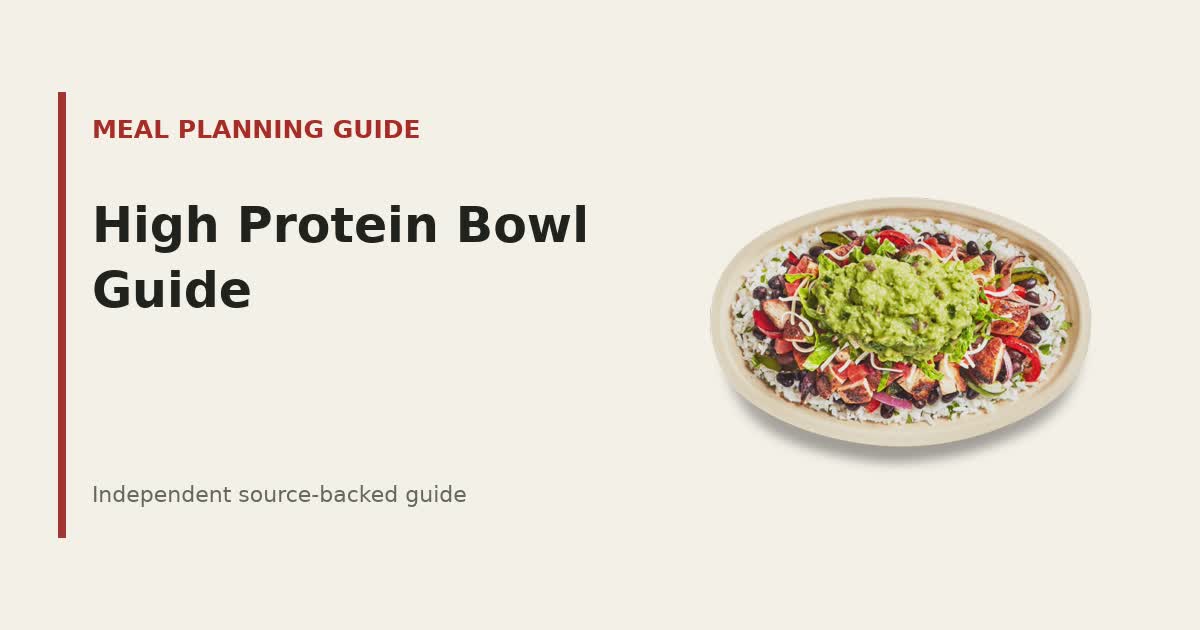
Chipotle’s named High Protein – Low Calorie Bowl is listed at 470 calories with a “36g Protein | GLP-1 Friendly” tag in this site’s dated official snapshot. Those are whole-preset facts published with the meal. The local evidence does not provide a safe complete nine-field reconstruction of every modifier in that preset, so this guide keeps it separate from custom Chipotle calorie calculator arithmetic rather than inventing missing macros.
The official named bowl at a glance
The preset collection stores the name High Protein – Low Calorie Bowl, a 470-calorie total, and a 36-gram protein tag. It also preserves “GLP-1 Friendly” as wording attached to the official meal record. This independent site reports that label only to identify the preset; it is not a medical endorsement, a statement about medication effects, or individualized nutrition advice.
The 470 and 36 values describe the named meal as published. They should not be applied to every bowl that sounds high in protein, and they should not be combined with a custom ingredient list unless the added or removed items are known. Use the Chipotle menu calories guide to find the preset card, and check the official Chipotle nutrition calculator for current availability or changes after this site’s snapshot date.
- Named preset: High Protein – Low Calorie Bowl.
- Published preset total: 470 calories.
- Published tag: 36g Protein | GLP-1 Friendly.
- The label is first-party menu wording, not health guidance from this site.
Why the preset is not a full calculator row
The custom calculator accepts rows with a stable identity, a clear portion, and all nine displayed nutrition fields. The preset evidence supplies a useful meal-level calorie value and protein tag, but its light, extra, or included modifier details cannot be reconstructed into every field with the same confidence. Turning the record into a custom row would require assumptions about quantities and ingredients that are not present in the normalized evidence.
Keeping the preset separate protects the distinction between a published whole-meal total and arithmetic built from exact ingredient servings. It also prevents a user from selecting the complete preset and then accidentally adding its components again. When you want that named order, use 470 calories and 36 grams of protein as the preset reference. When you want a custom order, build it from individual rows and let the calculator total those selections.
A transparent custom Chicken bowl example
A simple represented Bowl with Chicken, Black Beans, Fajita Vegetables, and Fresh Tomato Salsa totals 355 calories. The arithmetic is Bowl 0 + Chicken 180 + Black Beans 130 + Fajita Vegetables 20 + Fresh Tomato Salsa 25. The same exact rows provide 41 grams of protein: Chicken 32 + Black Beans 8 + Fajita Vegetables 1 + salsa 0. This is a calculator example, not the ingredient recipe for the named 470-calorie preset.
The example is intentionally limited so every number can be traced. It may not be the complete meal someone wants, and the Fresh Tomato Salsa contributes 550 milligrams of sodium in the represented serving even though it adds only 25 calories. That contrast shows why “low calorie” is not a complete nutrition description. Review the full summary rather than optimizing one number in isolation.
- Chicken: 180 calories and 32g protein.
- Black Beans: 130 calories and 8g protein.
- Fajita Vegetables: 20 calories and 1g protein.
- Fresh Tomato Salsa: 25 calories and 0g protein.
- Custom represented total: 355 calories and 41g protein.
Chicken versus Steak in the same custom structure
Replacing Chicken with Steak while keeping Black Beans, Fajita Vegetables, and Fresh Tomato Salsa produces 325 calories and 30 grams of protein. Steak contributes 150 calories and 21 grams of protein; the other three rows contribute 175 calories and 9 grams of protein together. Compared with the Chicken version, the Steak build is 30 calories lower and 11 grams of protein lower in this standardized example.
That comparison does not declare one protein universally preferable. It demonstrates how to hold the rest of a meal constant while reading a tradeoff. Restaurant portions can vary, and a personal choice may depend on taste, ingredients, fat, sodium, or other concerns. Build both versions in the tool and examine every field that matters to your planning rather than selecting a protein from calories and protein alone.
How rice and richer add-ons change the calculation
One represented adult White Rice or Brown Rice portion adds 210 calories and 4 grams of protein. Adding rice to the 355-calorie Chicken example makes 565 calories and 45 grams of protein. The rice can make the meal more substantial, but it moves that custom total above 500. This does not conflict with the 470-calorie preset because the custom example is a different ingredient set.
Guacamole adds 230 calories and 2 grams of protein per represented portion. Chipotle Honey Vinaigrette adds 220 calories and 1 gram of protein. Cheese, sour cream, chips, queso, and other choices have their own profiles. None must be excluded by this guide; the point is to count each deliberately. A calorie-dense add-on may be worth keeping for flavor, while a different component can be adjusted if a target matters.
Double protein is a modeled quantity, not a scoop measurement
Two complete represented Chicken portions contribute 360 calories and 64 grams of protein. With Black Beans, Fajita Vegetables, and Fresh Tomato Salsa, that modeled bowl totals 535 calories and 73 grams of protein. The quantity control makes the two-portion assumption explicit. It does not prove that a restaurant’s “double chicken” serving weighs exactly twice one standard portion.
Hand-served amounts may be above or below the source serving, and visual size is not a reliable scale. Use a double-row result to compare two standardized portions, not to claim precision about a prepared bowl. The same caution applies to light rice, extra beans, or extra salsa. If the requested amount is not measured, keep the uncertainty visible rather than converting an informal instruction into an exact official quantity.
How to build a high-protein, calorie-aware comparison
Start with Bowl so the container contributes 0 calories, then choose one represented protein. Add beans or another component only if it belongs in the planned meal. Add vegetables, salsa, rice, toppings, dressing, sides, and drinks one at a time while watching both calories and protein. Copy the summary before a major swap so the effect of that single change remains easy to see.
Decide whether you are researching the named 470-calorie preset or building a custom meal; do not merge the two methods. For a custom build, state portion assumptions and review sodium, carbohydrates, fiber, fat, and allergen context along with the headline numbers. The nutrition and sources guide documents what each total means, and the official Chipotle allergen guidance should guide current allergy or strict restriction checks with restaurant staff.
- Use the preset’s 470 calories and 36g protein only for the named preset reference.
- For custom bowls, add exact represented rows and keep quantity assumptions visible.
- Compare one protein, rice, topping, or dressing change at a time.
- Review the complete nutrition summary and current official information before ordering.
The practical takeaway
The direct answer is that Chipotle’s named High Protein – Low Calorie Bowl is published at 470 calories and 36 grams of protein in this snapshot. Its GLP-1 Friendly tag is an official menu label, not advice from this independent site. Because the available modifier evidence is incomplete, do not manufacture a full macro panel or ingredient reconstruction for that preset.
For a custom comparison, exact rows can still produce transparent results: the Chicken, Black Beans, Fajita Vegetables, and Fresh Tomato Salsa example is 355 calories and 41 grams of protein; the Steak version is 325 and 30. Those numbers describe the represented ingredients only. Use the Chipotle calorie calculator for your complete selection and browse other Chipotle nutrition guides for focused rice, guacamole, vinaigrette, tortilla, and portion explanations.
Check the current menu before ordering
This independent guide uses a dated official nutrition snapshot for repeatable comparisons. Recipes, availability, listed values, and restaurant portions can change. Use Chipotle's current information for ordering, allergy, and dietary decisions.