
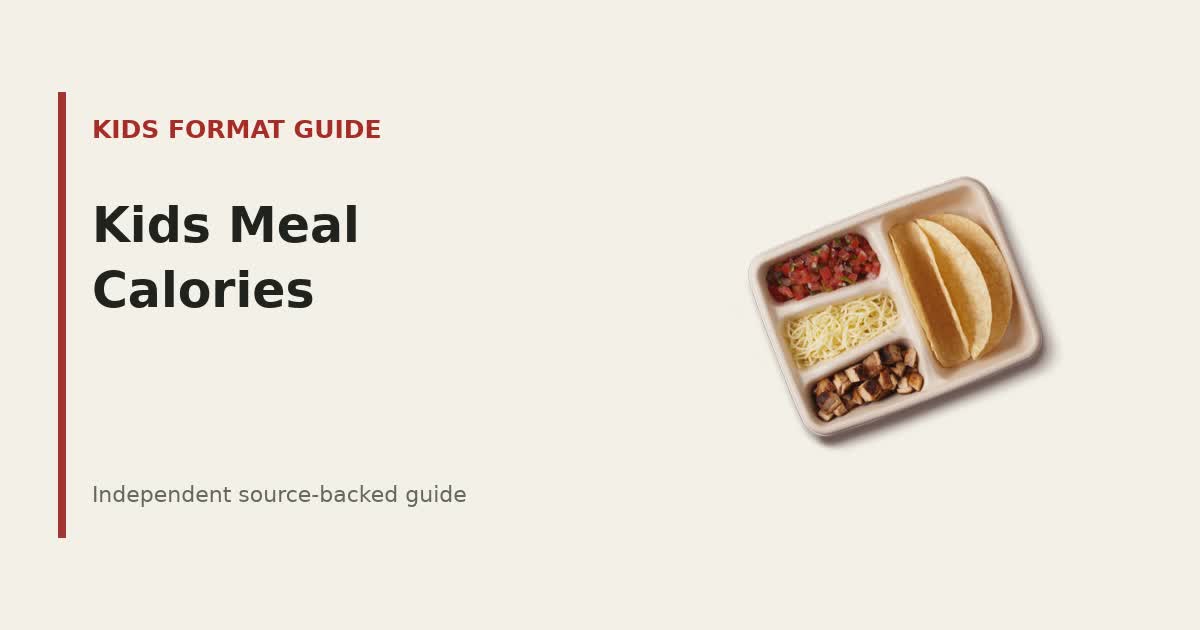
Chipotle kids meal calories begin with the selected format, then rise as protein, a side, a drink, and any other represented items are added. In this site’s dated snapshot, Kids’ Build-Your-Own Soft starts at 170 calories, Kids’ Build-Your-Own Crispy starts at 140, and Kids’ Quesadilla starts at 190. Those values are not automatic totals for every possible meal. Build the actual combination in the Chipotle calorie calculator with kids-specific rows.
What each kids meal starting format includes
The Kids’ Build-Your-Own Soft format contributes 170 calories before the selected protein, side, drink, or other added rows. The Kids’ Build-Your-Own Crispy format contributes 140. The 30-calorie difference belongs to the source-defined shell formats. It should be kept separate from any difference created by Chicken, Steak, beans, toppings, or sides.
The Kids’ Quesadilla starts at 190 calories. Its represented base includes the quesadilla format components, including its tortilla and cheese contribution. Adding a kids protein means adding that protein to 190; it does not replace the complete quesadilla base. The Chipotle menu calories guide lists all three formats independently so a 140-, 170-, or 190-calorie starting value is not mistaken for a finished tray.
Menu packaging and included choices can change, and the calculator does not enforce restaurant ordering rules. Its purpose is transparent arithmetic. Select only the food and drink expected to be consumed, avoid assuming that every possible side is already included, and retain the named format with the result.
- Kids’ Build-Your-Own Soft starting format: 170 calories.
- Kids’ Build-Your-Own Crispy starting format: 140 calories.
- Kids’ Quesadilla starting format: 190 calories.
- Protein, side, drink, and optional items must be selected separately.
Kids Chicken vs Kids Steak calories and protein
Kids’ Chicken is represented by a 2 oz row with 90 calories and 15 grams of protein. Kids’ Steak is represented by a 2 oz row with 70 calories and 10 grams of protein. Substituting Kids’ Steak for Kids’ Chicken lowers a controlled example by 20 calories and changes the other nutrition fields too. That numerical comparison is not a recommendation for a child or a judgment about which protein is appropriate.
Add Kids’ Chicken to the soft build-your-own format and the subtotal is 170 + 90 = 260 calories. Add it to the crispy format and the subtotal is 140 + 90 = 230. Add it to the Kids’ Quesadilla base and the subtotal is 190 + 90 = 280. These figures still exclude a side, drink, and any additional represented choice.
With Kids’ Steak, the corresponding subtotals are 240 for soft build-your-own, 210 for crispy build-your-own, and 260 for the quesadilla: 170 + 70, 140 + 70, and 190 + 70. The nutrition and sources guide shows why calories and protein should remain attached to the exact kids portion rather than copied from an adult entrée row.
- Kids’ Chicken: 90 calories and 15g protein per represented 2 oz portion.
- Kids’ Steak: 70 calories and 10g protein per represented 2 oz portion.
- Soft + Kids’ Chicken: 260 calories; Soft + Kids’ Steak: 240.
- Crispy + Kids’ Chicken: 230 calories; Crispy + Kids’ Steak: 210.
How kids sides and drinks change the total
Kids’ Chips are 140 calories per represented 1 oz portion, while Kids’ Fruit is 35 calories per represented 2.5 oz portion. The 105-calorie difference changes a complete modeled meal, but calories alone do not establish which side is suitable for an individual child. Portion acceptance, allergies, dietary needs, and guidance from a parent, caregiver, or qualified professional may matter more than one number.
Organic Apple Juice is represented by a 6.75 oz row at 100 calories. It must be added separately to the meal. Organic Milk is a different 8 oz record at 110 calories, and Organic Chocolate Milk is an 8 oz record at 160. Choose the exact drink row rather than applying the apple juice value to every beverage.
Sides and drinks should not be hidden in the base. A 260-calorie Soft + Kids’ Chicken subtotal becomes 400 with Kids’ Chips and 500 with Kids’ Chips plus Organic Apple Juice. The same protein and format with Kids’ Fruit becomes 295, then 395 with Organic Apple Juice. Each step adds the named row once.
- Kids’ Chips: 140 calories per represented 1 oz portion.
- Kids’ Fruit: 35 calories per represented 2.5 oz portion.
- Organic Apple Juice: 100 calories per represented 6.75 oz portion.
- Soft + Kids’ Chicken + Chips + Apple Juice: 170 + 90 + 140 + 100 = 500 calories.
Worked kids meal calorie examples
A Crispy Build-Your-Own meal with Kids’ Steak, Kids’ Fruit, and Organic Apple Juice totals 345 represented calories: 140 + 70 + 35 + 100. The base contributes 140, protein contributes 70, side contributes 35, and drink contributes 100. No salsa, guacamole, queso, chips, milk, or other item is included unless it is added.
A Kids’ Quesadilla with Kids’ Chicken, Kids’ Chips, and Organic Apple Juice totals 520 represented calories: 190 + 90 + 140 + 100. Swapping Kids’ Chips for Kids’ Fruit changes that example to 415 because 190 + 90 + 35 + 100 = 415. The controlled side swap accounts for the 105-calorie difference.
These examples demonstrate the calculation method; they are not meal plans or nutrition advice for children. An appropriate intake depends on individual circumstances that this website cannot assess. Use the nutrition disclaimer for the tool’s scope and consult a qualified healthcare or nutrition professional when personalized guidance is needed.
- Crispy + Kids’ Steak + Fruit + Apple Juice: 345 calories.
- Quesadilla + Kids’ Chicken + Chips + Apple Juice: 520 calories.
- Quesadilla + Kids’ Chicken + Fruit + Apple Juice: 415 calories.
Do not substitute adult ingredient records
The kids and adult protein rows are separate. Kids’ Chicken is a represented 2 oz portion at 90 calories, while adult Chicken is a 4 oz portion at 180. Kids’ Steak is 2 oz and 70 calories, while adult Steak is 4 oz and 150. The steak values show why it is unsafe to assume every smaller record is always exactly half of the adult value.
The same separation applies to Kids’ Chips, Kids’ Guacamole, and other kids-specific rows. Kids’ Chips are 1 oz and 140 calories, while the adult Tortilla Chips row is 4 oz and 540. Kids’ Guacamole is 2 oz and 110 calories, while the adult Guacamole row is 4 oz and 230. Select the row named for the kids portion when that is what the scenario uses.
Portion labels make the assumptions auditable. If a restaurant serves an amount that differs from the standardized record, the calculator cannot infer its weight from the order name. Avoid mixing adult and kids values to force a preferred total, and do not present a visual fraction as a new official portion.
How to calculate a kids meal step by step
Begin by selecting Kids’ Build-Your-Own Soft, Kids’ Build-Your-Own Crispy, or Kids’ Quesadilla. Confirm the starting calories before adding anything. Next select the kids-specific protein and any represented fillings or toppings. Then add the side and drink actually expected to be consumed. Review the selected list so no item appears twice and no combined choice is counted again as separate components.
Use one change at a time for comparisons. To compare Chicken and Steak, preserve the format, side, and drink while swapping only the protein. To compare Chips and Fruit, preserve the format, protein, and drink while swapping only the side. This controlled process shows which row moved the result and prevents several changes from being attributed to one choice.
Finally, review calories, fat, saturated fat, sodium, carbohydrates, fiber, sugar, protein, serving sizes, and available allergen context. The copied summary can preserve the exact selections. It should be described as a standardized scenario, not a measured restaurant tray or a prescription for a child.
- Select and verify the starting format.
- Add the kids-specific protein and every other intended food row.
- Add the exact side and drink separately.
- Compare one substitution at a time and keep the portion labels visible.
Allergens and individual nutrition needs require current guidance
A calorie calculator cannot determine whether a meal is appropriate for a particular child. Age, growth, medical conditions, allergies, activity, appetite, and the rest of the diet are outside this site’s knowledge. Parents and caregivers should use qualified professional guidance for individual nutrition or medical questions rather than treating these examples as targets.
Allergen decisions also require current information. Review the official Chipotle allergen guidance and ask restaurant staff about ingredients and cross-contact when a restriction matters. A stored tag or empty allergen list is not a guarantee of safety, and recipe or handling changes can occur after the source snapshot.
Availability and included choices may vary. The calculator shows represented records, not prices, promotion terms, or what every location automatically packages with a kids meal. Verify current menu details when ordering and count only the items that match the actual selection.
Check current Chipotle information
The practical starting numbers are 170 calories for Kids’ Build-Your-Own Soft, 140 for Kids’ Build-Your-Own Crispy, and 190 for Kids’ Quesadilla. Kids’ Chicken adds 90, Kids’ Steak adds 70, Kids’ Chips add 140, Kids’ Fruit adds 35, and Organic Apple Juice adds 100 in the represented portions. A complete total is the sum of the exact format, foods, side, and drink selected.
These values come from a dated local snapshot and can become outdated. Check the official Chipotle nutrition calculator for current first-party values and portion descriptions before relying on them for a new order. Other Chipotle nutrition guides cover adult meal formats, tortillas, rice, toppings, protein, guacamole, and sauces; keep kids-specific rows separate whenever the goal is a kids meal comparison.
Check the current menu before ordering
This independent guide uses a dated official nutrition snapshot for repeatable comparisons. Recipes, availability, listed values, and restaurant portions can change. Use Chipotle's current information for ordering, allergy, and dietary decisions.